
How to Find Orleans Parish Arrest Records
The fastest route to a recent arrest is the Orleans Parish Sheriff's Office detainee query, which lists people currently in custody. For the court side of a charge, Criminal District Court holds the felony case file. Start with the jail for custody, then move to the court for the case.
- Open the OPSO detainee query and search by last and first name.
- Add a booking number or date of birth if the system accepts them, to avoid false matches.
- Read the result for booking date, charges, bond, and facility.
- If the person is not listed, check spelling, recent release, or a transfer to state or federal custody.
- For the case itself, search the Criminal District Court records and the criminal clerk.
For the live jail roster and its fields, see the Orleans Parish inmate records page. Older booking events may no longer appear in the active query and may require a record request.
Arrest Records vs Criminal Court Records
People often use these terms as if they mean the same thing. They do not. An arrest record comes from the agency that made the arrest and the jail that booked the person. A criminal court record comes from the clerk after a case is filed. One shows custody and charges at intake; the other shows what the court did with the case.
| Feature | Arrest Record | Criminal Court Record |
|---|---|---|
| Source | Police and the sheriff's jail | Criminal District Court Clerk |
| Created | At arrest and booking | After a case is filed |
| Shows | Booking, charges, bond, custody | Dockets, pleas, judgments, sentences |
| Outcome | Not a finding of guilt | Final disposition of the charge |
For full case history, use the Orleans Parish court records page rather than the jail query.
Booking Records and the Jail Roster
Booking happens after an arrest by the New Orleans Police Department, the sheriff, or another agency. Intake includes an identity check, a warrants check, a property inventory, and a medical and mental-health screening. A booking photo and fingerprints follow, then a magistrate or bond process under Louisiana procedure. Once processed, and unless restricted, the detainee record appears in the public query.
A booking record is a snapshot. It can change minute to minute as bond is posted, charges are added, or a person is released or transferred. That is why the jail query should not be the only proof of custody when the stakes are high; a phone call or a court document is safer.
Mugshots in Orleans Parish
A booking photo, often called a mugshot, may appear in the public detainee record when the system exposes it. A mugshot marks an arrest, not a conviction. Many people whose photos appear are later released, never charged, or found not guilty. Treat a booking image as a record of intake, nothing more.
Note: Third-party mugshot and people-search sites are not official Orleans Parish sources, and their data is often outdated or wrong.
Charges vs Convictions
This distinction matters more than any other on an arrest record. A charge is an accusation. A conviction is a court finding of guilt. In Louisiana, felony charges are usually brought by a bill of information filed by the prosecutor or by a grand jury indictment. None of that proves guilt. Only the disposition does.
| Point | Charge | Conviction |
|---|---|---|
| Meaning | An accusation by the state | A court finding of guilt |
| Document | Bill of information or indictment | Judgment or sentencing minute |
| Certainty | Not proof of wrongdoing | The legal outcome of the case |
A case can end in dismissal, acquittal, a plea, or a conviction, so always read the disposition before drawing a conclusion.
What an Orleans Parish Arrest Record Shows
A public detainee or arrest record carries a standard set of fields. Sensitive items are limited or held back.
- Name and booking number - the person's name and a unique jail identifier.
- Booking date and facility - intake date and the custody location.
- Charges - charge text and sometimes the statute or code.
- Arresting agency - NOPD, the sheriff, or a state or federal agency.
- Bond - bond amount and type per charge when set.
- Holds or warrants - detainers or warrants where public.
Medical status, protective custody, victim data, and juvenile details are not part of a public arrest record.
Sealed and Expunged Arrest Records
Louisiana lets people limit public access to eligible arrest and conviction records. Sealing and expungement are related but not identical, and both require a court process. Expungement is defined and governed by the Code of Criminal Procedure, with separate articles for misdemeanors and felonies.
| Feature | Sealed | Expunged |
|---|---|---|
| Effect | Restricts public inspection | Removes from ordinary public access |
| Common use | Juvenile and certain court files | Eligible adult arrests and convictions |
| Agency access | May remain for authorized parties | May remain for limited official use |
The full eligibility rules and the filing steps are covered on the court records page. Juvenile records follow the Children's Code, a different track from adult expungement.
The District Attorney and Public Defender
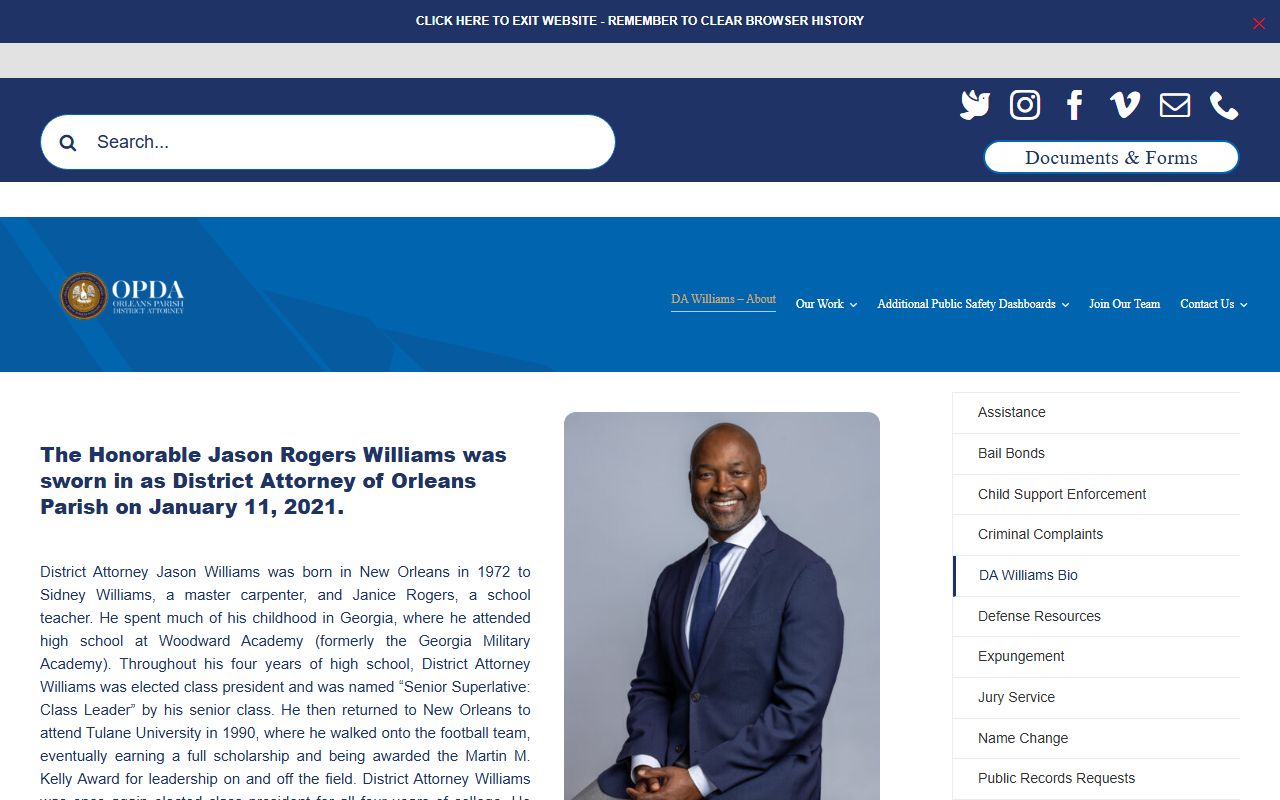
Two offices shape what happens after an arrest. The Orleans Parish District Attorney decides whether and how to charge a case, and runs victim services and diversion programs. Its official site is shown below.
On the defense side, the Orleans Public Defenders represent eligible people who cannot afford a lawyer in criminal cases. Their site is shown here.

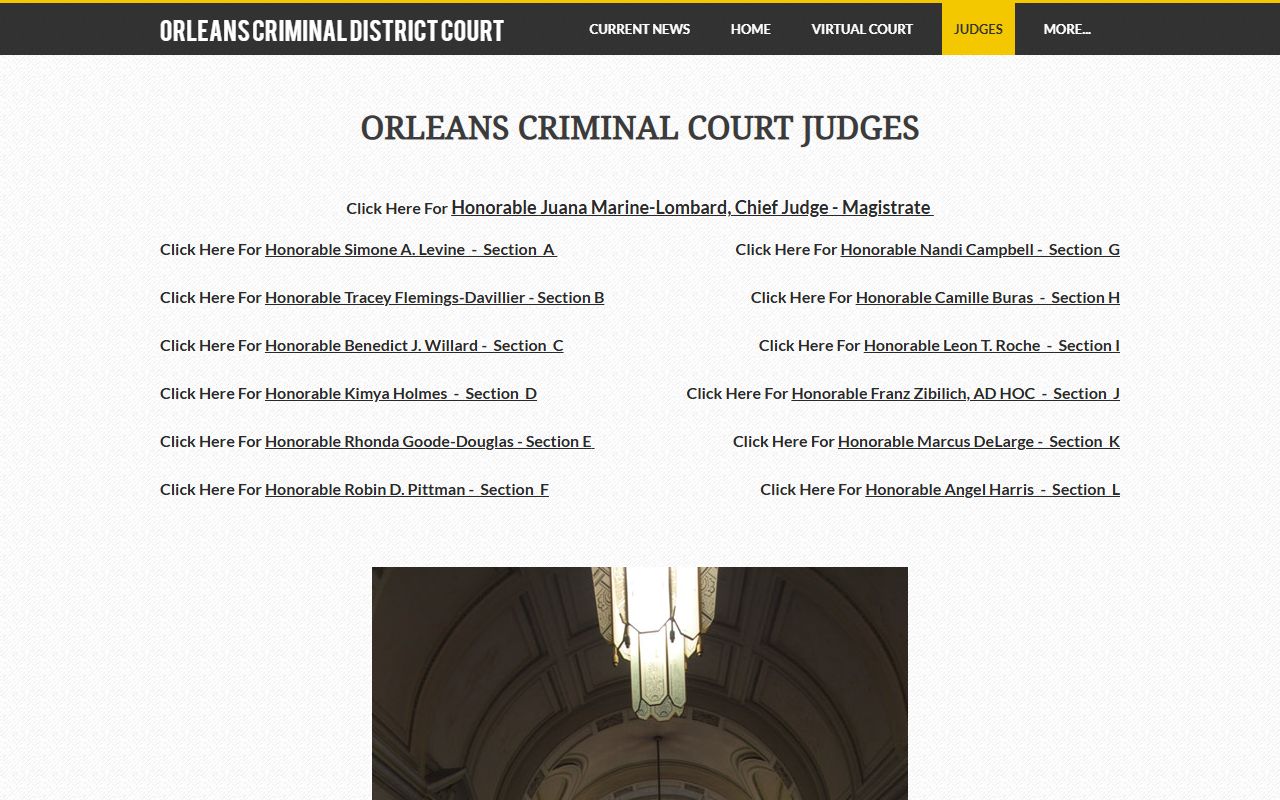
Felony cases are heard before the judges of Criminal District Court, whose divisions are listed on the court's judges page, shown below.
Together these offices and judges move an arrest from booking to a final court outcome.
State and Federal Criminal Records
Some criminal history sits above the parish level. The Louisiana State Police handle statewide criminal background checks, which pull from records across the state, not just New Orleans. Federal criminal cases are not held by Orleans Parish at all; they are prosecuted in the U.S. District Court for the Eastern District of Louisiana and searched through PACER. Warrants tied to a missed court date are covered on the warrant records page, and DUI matters often overlap with traffic court records.
Requesting an Arrest or Incident Report
The jail query shows custody, but the written arrest or incident report is a separate document held by the arresting agency. For most New Orleans arrests, that agency is the police department. These reports fall under Louisiana's public-records law, though active investigative material can be withheld under La. R.S. 44:3.
A few points help when you ask for a report. Have the date, location, and the names involved ready. Know that an open case may delay release of the narrative while basic arrest and booking facts stay public. Expect a copy fee, and expect redaction of victim and juvenile information. The broader request process, including how the city handles police records, is laid out on the Orleans Parish public records page.
Note: An arrest report and a court record are different documents; one comes from police, the other from the criminal clerk after charges are filed.