
How to Search Orleans Parish Court Records
The search path depends on the case. Civil suits, divorce, custody, succession, and foreclosure files belong to the Clerk of Civil District Court. Land transfers, mortgages, and notarial acts go through that same office's Land Records Division. Felony and major criminal matters route through Criminal District Court and its separate clerk. Traffic tickets and city ordinance cases sit with the Municipal and Traffic Court of New Orleans. Juvenile files are confidential and are not searched like adult cases.
Civil and land records are reached through the clerk's own systems. The official routing point is the civil clerk's online records page, which directs users to the remote access portal. The screenshot below shows that page and how it frames public access.
The civil clerk's online records page lays out which divisions are searchable and where to log in for deeper document views.
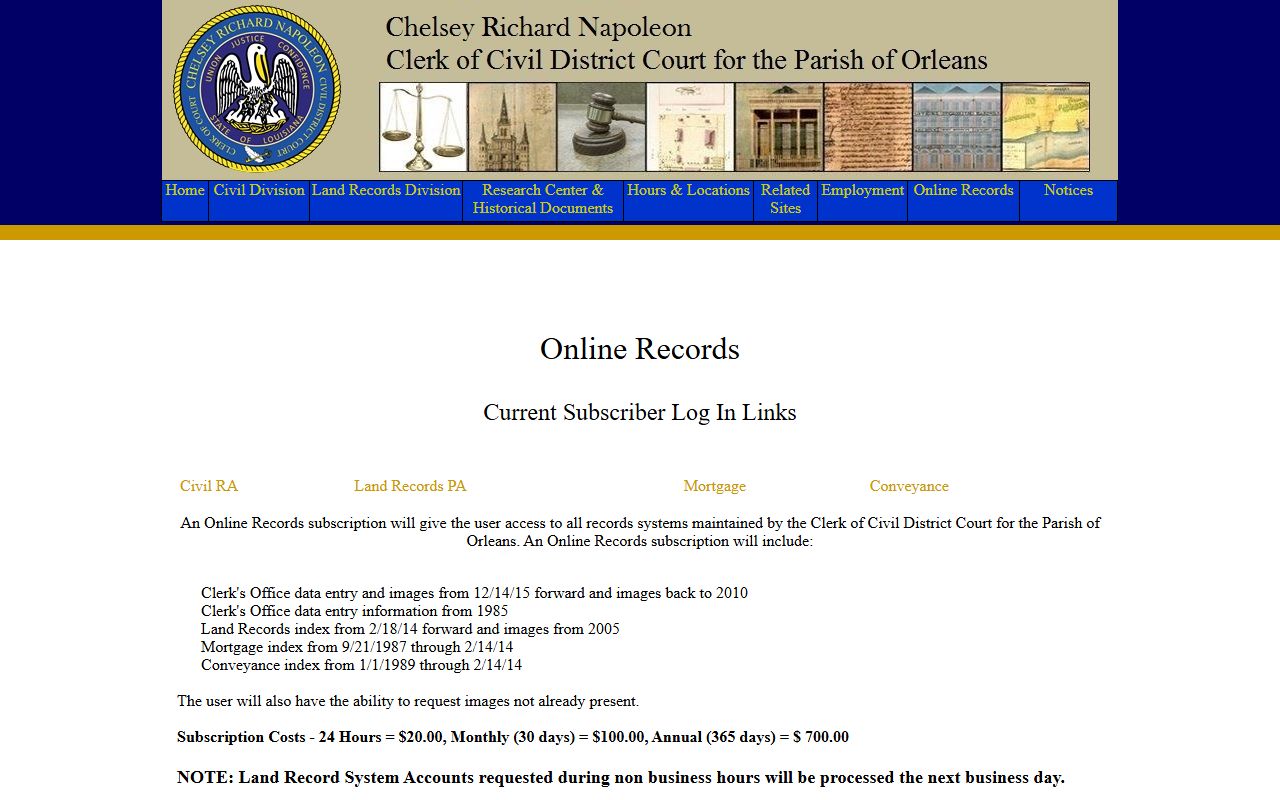
That page links to the live search system, where most civil and land lookups actually happen. Here is the basic civil and land workflow:
- Pin down the record type. Civil, domestic, succession, and foreclosure files are Civil District Court; transfers, mortgages, and liens are Land Records.
- Open the civil and land remote access portal from the clerk's site.
- Search by case or instrument number when you have it. Otherwise use party name and a date range.
- Use exact spelling. Older notarial records may need a notary name and act date instead of a modern number.
- Read the result summary for case number, parties, filing date, division, and document availability.
- If a file is not online or you need a certified copy, email the clerk at cdcclerk@orleanscivilclerk.com with the case details.
For felony matters, start at the Criminal District Court site for divisions, rules, and clerk contact. For current custody, the Orleans Parish Sheriff's detainee query is the right tool, not the court docket.
The Orleans Parish Court System
Louisiana starts with the Louisiana Supreme Court, then the circuit courts of appeal, then district courts, then limited courts for city, traffic, municipal, and juvenile matters. The state's high court explains this hierarchy in its court FAQ. Orleans Parish appeals normally go to the Louisiana Fourth Circuit Court of Appeal, which sits in New Orleans. The Louisiana Supreme Court is also in the parish, at 400 Royal Street.
What makes Orleans Parish unusual is the split at the trial level. Most parishes run one district court and one clerk. New Orleans runs a separate Civil District Court and Criminal District Court, each with its own clerk and its own building. A lawsuit and a felony case are never searched in the same office.
| Court | Jurisdiction | Case Types |
|---|---|---|
| Louisiana Supreme Court | Highest state court | Final review of Louisiana law |
| Fourth Circuit Court of Appeal | Intermediate appeals | Appeals from Orleans Parish trial courts |
| Civil District Court | General civil trial court | Civil suits, divorce, succession, foreclosure |
| Criminal District Court | General criminal trial court | Felony and major criminal cases |
| Municipal and Traffic Court | Limited city court | Traffic and city ordinance cases |
| Orleans Parish Juvenile Court | Limited juvenile court | Delinquency, child protection, FINS |
Case flow: Municipal/Traffic or District Court › Civil or Criminal District Court › Louisiana Fourth Circuit Court of Appeal › Louisiana Supreme Court
Because the two trial courts are split, it helps to compare them side by side before you pick a search tool. The table below sets out the core difference.
| Feature | Civil District Court | Criminal District Court |
|---|---|---|
| Address | 421 Loyola Avenue | 2700 Tulane Avenue |
| Clerk | Clerk of Civil District Court | Criminal District Court Clerk |
| Records | Civil, domestic, succession, land | Felony dockets, bonds, judgments |
| Online access | Civil and land remote access | Clerk contact and court site |
The criminal court keeps its own clerk page for contact and records routing, shown here.
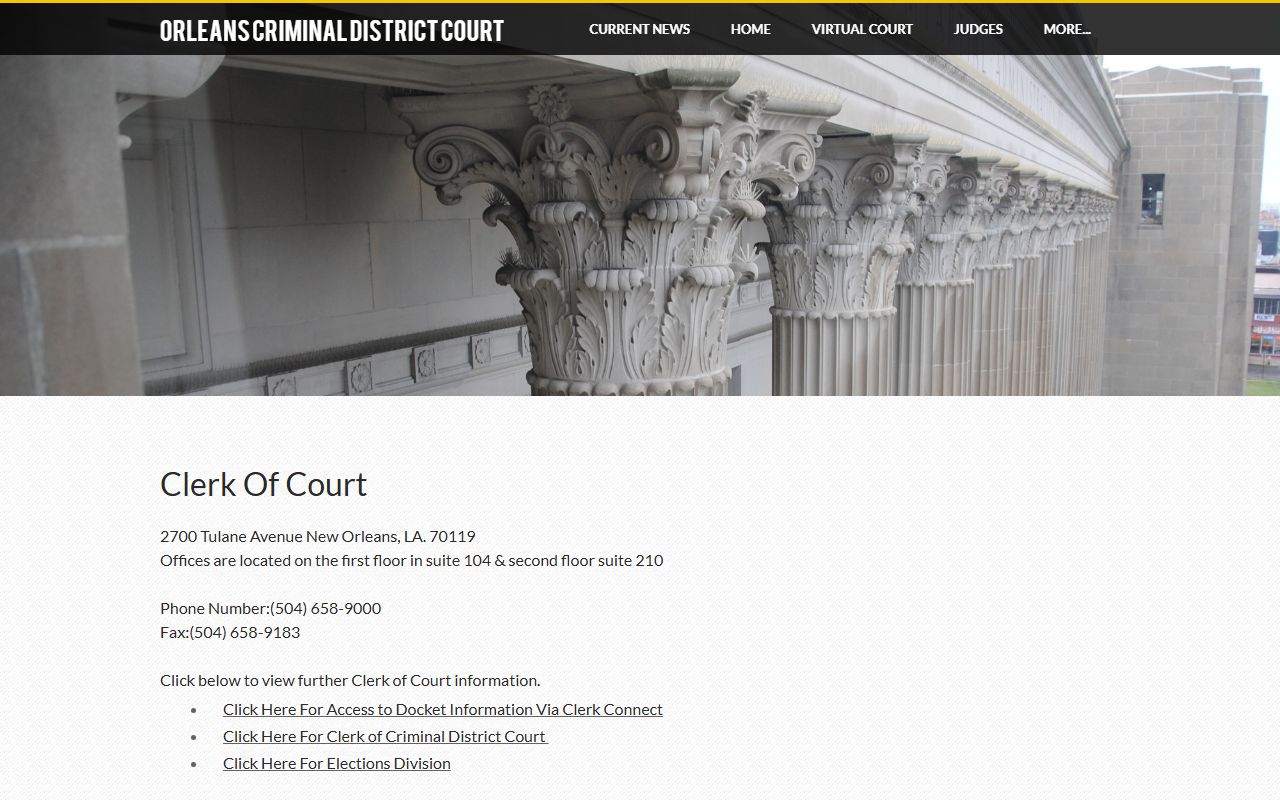
That page is the starting point for felony docket questions and criminal certified copies.
Orleans Parish Courthouses
There is no single Orleans Parish courthouse. The courts sit across a downtown civic-center cluster in New Orleans. Civil District Court and the civil clerk's Civil Division are at 421 Loyola Avenue. The Land Records Division and Notarial Archives operate at 1340 Poydras Street. Criminal District Court is at 2700 Tulane Avenue. Municipal and Traffic Court is at 1601 Perdido Street. The Louisiana Supreme Court is at 400 Royal Street.
The civil clerk's office, led by Clerk of Court and Ex-Officio Recorder Chelsey Richard Napoleon, anchors most public records work. Its official homepage describes the Civil and Land Records divisions and lists the public-records email. The home page also posts live notices, such as system maintenance windows and legal-holiday closures, which signal an actively maintained set of public systems.
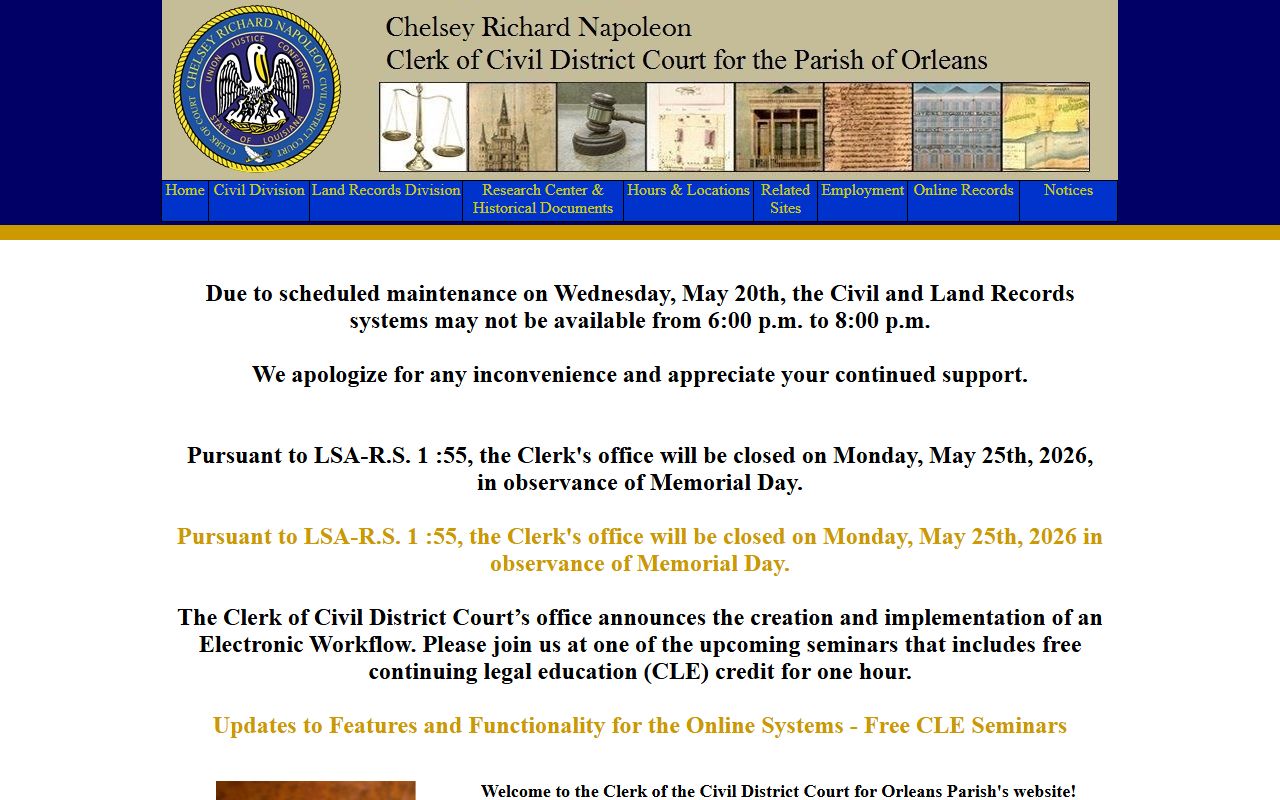
The homepage shown above is the cleanest entry point for civil filings, land records, and copy requests. To confirm which building handles your task, the clerk's hours and locations page lists the Loyola Avenue and Poydras Street addresses.
Civil District Court
421 Loyola Avenue
New Orleans, LA 70112
cdcclerk@orleanscivilclerk.com
Criminal District Court
2700 Tulane Avenue
New Orleans, LA 70119
Criminal District Court Clerk
Land Records & Archives
1340 Poydras Street, Suite 500
New Orleans, LA
Notarial Archives at Suite 360
Types of Court Records Available in Orleans Parish
Orleans Parish court records cover a wide range of case types, and each kind sits with a specific court. Most files are public unless a statute or court order seals them. The split court structure means civil and criminal records are never mixed in one system, so it pays to know the category before you search.
These are the main record groups and where each one lives:
- Civil records - lawsuits, contracts, property disputes, and foreclosures filed in Civil District Court.
- Family and divorce records - divorce, custody, and support cases handled by the civil clerk.
- Succession records - Louisiana's term for probate estate files, also in Civil District Court.
- Criminal records - felony bills, minute entries, bonds, and sentencing from Criminal District Court.
- Traffic and municipal records - citations and city ordinance cases from Municipal and Traffic Court.
- Land and notarial records - transfers, mortgages, liens, and historic notarial acts.
Juvenile files are a special case. The Louisiana Children's Code keeps them confidential, so they are not part of a normal public records search.
What Orleans Parish Court Records Show
A court file is more than a name and a number. Each record carries fields that tell you who is involved, what the case is about, and where it stands. The civil and land remote access portal exposes many of these fields in its search results, and the criminal court docket carries a parallel set for criminal matters.
The civil and land remote access portal is the live search tool behind most civil and property lookups. Its landing page is shown below.
Once a record opens, these are the common fields you will read:
| Field | What It Shows |
|---|---|
| Case Number | Court-specific docket or instrument number; civil and criminal formats differ. |
| Filing Date | Date the petition or document entered the clerk's record. |
| Parties | Plaintiff and defendant, petitioner and respondent, or decedent and heirs. |
| Charges / Cause | The civil claim, or the criminal charge text and statute. |
| Docket Entries | Chronological log of filings, hearings, orders, and judgments. |
| Disposition | Outcome such as judgment, dismissal, plea, or sentence. |
Sensitive data is held back. Social Security numbers, financial account numbers, juvenile names, and protected victim details should not appear in a public record view.
Public Access Laws for Orleans Parish Court Records
Louisiana's public-records framework sits in Title 44 of the Revised Statutes. The default rule is access: most records held by a public office are open to inspection. Court records also answer to court rules, juvenile confidentiality, criminal-investigation limits, and expungement law. For Orleans Parish, that means you start with the official clerk, court, or sheriff portal, then expect exceptions for sealed, juvenile, expunged, and active investigative files.
Key Statutes:
La. R.S. 44:1 - defines public bodies and public records, the test for what falls under the law.
La. R.S. 44:31 - gives any adult the right to inspect and copy public records unless an exemption applies.
La. R.S. 44:32 - sets the custodian's duties for producing records and charging lawful copy fees.
La. R.S. 44:3 - exempts active law-enforcement and investigative records from immediate release.
Disputes over access can be taken to court, and a custodian who denies a request should cite the legal basis. The full list of exceptions is cataloged in La. R.S. 44:4.1, and court-specific procedures are set by the Louisiana Supreme Court rules. More detail sits on the Orleans Parish public records page.
Records That Are Restricted or Confidential
Not every Orleans Parish court record is open. Juvenile court files are confidential under La. Children's Code art. 412. Expunged adult criminal records are pulled from ordinary public access under the Code of Criminal Procedure. Grand jury material, adoption files, sealed exhibits, and protected victim and medical information are also withheld or redacted.
Sealing and expungement are court processes, not automatic events. To limit access to an eligible criminal record, a person files a petition in the court tied to the arrest or prosecution. The court can deny it for unpaid costs, a statutory exclusion, a short waiting period, or a prior disqualifying conviction. A sealed record may still be reachable by certain agencies for authorized use.
Specialty Courts in Orleans Parish
Criminal District Court runs problem-solving programs instead of putting every defendant on a standard docket. These specialty courts mix judicial supervision, treatment, compliance reviews, and incentives. Eligibility usually turns on the charge, criminal history, a clinical assessment, and approval from the court and the district attorney.
Two programs stand out. A drug or treatment court targets people whose offenses tie back to substance use, using testing, frequent status hearings, and graduated sanctions. A mental health or behavioral health docket serves defendants with verified clinical needs, pairing treatment plans and medication compliance with regular court review. Confidential health details from these programs stay out of the ordinary public record.
Orleans Parish Sheriff and Jail
The Orleans Parish Sheriff's Office runs the parish jail system and publishes a public detainee query. That query is the right tool for current custody status, while Criminal District Court is the source for the case docket. The two overlap but are not the same. A person can have an open court case without being in custody, and a jail record can show booking facts before the docket updates.
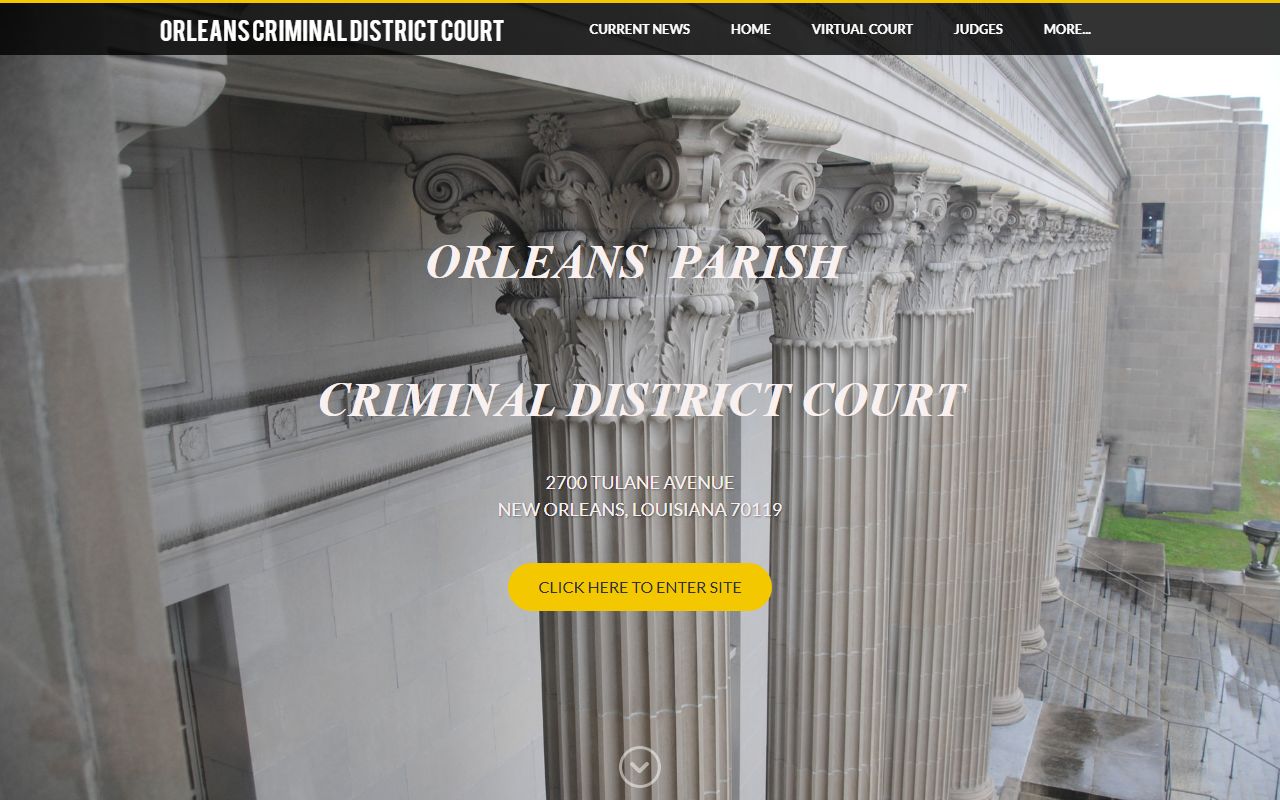
The criminal court's own site, shown here, is the official hub for felony divisions, rules, and clerk contact.
For the live jail roster and booking fields, see the Orleans Parish inmate records page. For active court-issued arrest orders, the warrant records page covers capias and bench warrants. Arrest and booking details are gathered on the arrest records page.
Marriage, Divorce, and Succession Records
Family and estate matters route through the civil court system, not a stand-alone office. Divorce, custody, and support cases are filed in Civil District Court and handled by the civil clerk. Successions, Louisiana's name for probate, are also filed there. Certified copies of a divorce judgment or a succession judgment come from the Clerk of Civil District Court. More detail sits on the marriage and divorce records and probate records pages.
Succession files use civil-law terms that confuse many first-time researchers. A short glossary helps:
- Testator
- The person who made a will, called a testament in Louisiana.
- Executor
- The person named to carry out a will and settle the estate.
- Intestate
- Dying without a valid will, so state law sets the heirs.
- Judgment of Possession
- The succession judgment that places heirs into possession of property.
Orleans Parish Court Records Fees
Copies and recordings carry fees at the clerk's office. Plain inspection of a public record is generally free, but printed copies, certified copies, and recordings are charged. The civil clerk publishes separate fee schedules for civil filings and for land records, and the exact amounts should be confirmed against the current schedule before you rely on them.
| Item | Source |
|---|---|
| Civil filing fees | Civil District Court filing fee schedule |
| Land recording fees | Land Records fee page |
| Plain and certified copies | Civil clerk and Land Records pages |
| Documentary tax | Applies to certain land and document transactions |
Certified copies cost more than a simple look because certification is a clerk service. Land Records forms and recording instructions are listed on the clerk's forms page.
Note: Confirm any fee against the clerk's current published schedule before mailing payment, since filing and recording charges change over time.
How to Interpret Orleans Parish Court Records
Court files use shorthand. A docket lists events like a petition, an answer, a motion, a rule, a hearing, and a judgment. In criminal court you will see an arraignment, a bond setting, and a sentencing minute. A charge is not a conviction. An arrest or a bill of information shows what the state alleges; only a disposition shows the outcome.
Louisiana terms trip up many readers. A "bill of information" is the prosecutor's charging document. A "capias" is a court order to arrest, often for a missed date. A "succession" is the estate process. Dismissed "with prejudice" ends a claim for good, while "without prejudice" may allow a refiling. When a code or abbreviation is unclear, the safest move is to ask the clerk that holds the file.
Accuracy and Record Limitations
Online records lag real events. A jail booking shows up after intake processing. A court docket updates after the clerk enters the filing. A certified copy is produced only after the clerk works the request. Treat an online result as a lead, not as final proof, when the stakes are high.
Note: Confirm any custody, release, or case detail with the originating clerk, court, or sheriff before relying on it, because public systems can lag operational changes.
History of Orleans Parish Courts
New Orleans is Louisiana's oldest and most legally distinctive city, and its records reflect that. The civil clerk's Notarial Archives hold documents dating back to the 1730s, used today for property, genealogy, architecture, and land-use research. That depth comes from the city's French and Spanish civil-law roots. Records after July 29, 1970 are pulled by NA number, while older records often need the notary's name and the date of the act. The separate Civil and Criminal District Courts, the Municipal and Traffic Court, and the Louisiana Supreme Court on Royal Street all sit within the parish, a concentration few Louisiana parishes share.
Frequently Asked Questions
Are Orleans Parish and Orleans County the same place?
Yes. Louisiana uses parishes instead of counties. Orleans Parish is the local government and court jurisdiction for New Orleans. A national site may say "county" for consistency, but official Louisiana sources say Orleans Parish.
Where is Civil District Court?
Civil District Court and the civil clerk are centered at 421 Loyola Avenue, New Orleans, LA 70112. Some land-record and historical research functions are at 1340 Poydras Street, so confirm the right office before a visit.
Where do I search current inmates?
Use the official Orleans Parish Sheriff's detainee query. Search by name or booking information. If no result appears, the person may be released, transferred, held by another agency, or not yet processed. See the inmate records page for the full workflow.
How do I get a certified copy?
Request certified civil and land copies from the Clerk of Civil District Court and criminal copies from the Criminal District Court Clerk. Provide the case number, party names, document name, filing date, and copy type.
More answers sit on the Orleans Parish court records FAQ page.